
If three suppliers offer you a “snow machine,” they may be quoting three very different systems. One creates a gentle curtain of falling snow, another covers a defined target, and a third builds a base across a larger site. The first question is simple: do you need snow in the air, on a target, or in volume?
This guide compares their effect, coverage, temperature limits, installation, and operating priorities from a buyer’s point of view.
|
Decision factor |
Snow falling machine |
Snow spray machine |
Snow cannon |
|
Primary job |
Create visible, gentle snowfall |
Put snow on a defined area |
Produce and distribute larger snow volumes |
|
Best fit |
Malls, hotels, atriums, celebrations, scenic zones |
Events, film sets, displays, small play zones, short slopes |
Snow parks, ski areas, large attractions, base building |
|
Snow behavior |
Fine flakes moving slowly through the air |
Directed, powdery spray with useful local accumulation |
Longer throw and heavier accumulation over wider terrain |
|
Typical planning focus |
Visual quality, noise, mounting position, guest comfort |
Throw direction, nozzle layout, air and water supply |
Output, weather window or refrigeration, utilities, terrain and grooming |
|
Buyer’s shorthand |
Atmosphere |
Targeted coverage |
Volume and area |
Manufacturers sometimes use “snow cannon” for both cold-weather fan guns and refrigerated, all-weather systems. They work differently, so always ask what process is behind the name.
A snow falling machine is designed around what guests see and feel. It creates a controlled fall zone with fine snow and a soft presentation—ideal above a Christmas street, hotel entrance, retail atrium, wedding set, or photo area.
For example, Focusun’s snow falling machine range includes different outputs for small displays and larger event spaces. The 600 kg/day snow falling machine is presented for applications where realistic flakes, adjustable snowfall, and quiet operation matter more than building a thick snow base.
Beautiful snowfall does not automatically mean efficient ground coverage. Wind, ceiling height, discharge position, drainage, and guest traffic change the result. For sledding, skiing, or play on a maintained layer, a falling machine is rarely the only production system.
A snow spray machine sits between atmosphere and mass production. It directs powdery snow toward a chosen surface for film sets, displays, ramps, and compact play areas.
Focusun’s professional snow spray machine uses water and compressed air, with single- and triple-nozzle arrangements for different coverage patterns. The published range includes mobile options and models intended for directional or broader spraying. This category suits projects where placement and flexibility matter: an operator can aim the effect where people will actually see or use it.
Do not select one from output alone. Ask about usable throw, rated temperature and humidity, snow dryness, compressor requirements, overspray, water treatment, and continuous operating time. A compact machine cannot become a high-capacity snow park plant just because the project grows.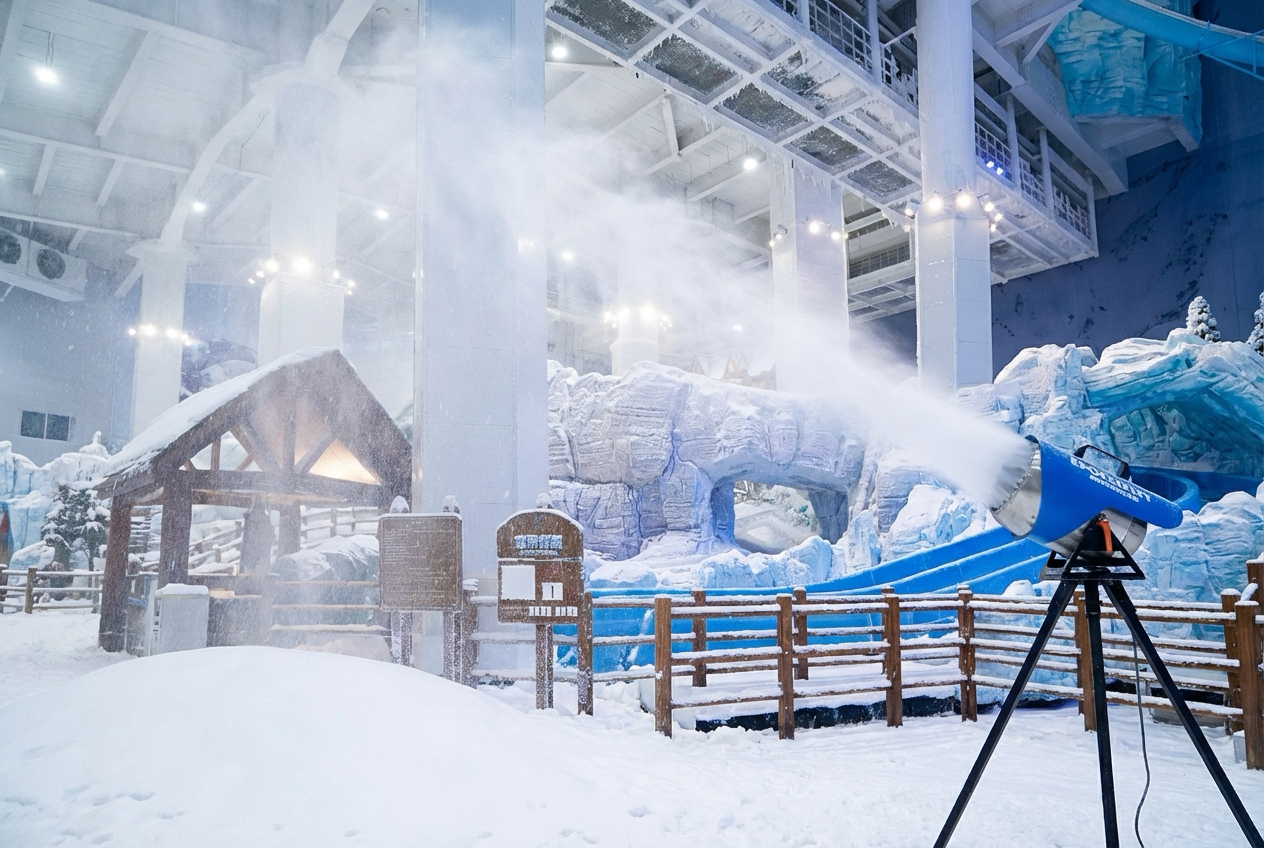
In conventional outdoor snowmaking, a snow cannon atomizes water into cold air. The droplets must freeze before landing, so wet-bulb temperature—not air temperature alone—controls the working window. These fan guns are well suited to ski terrain when the climate provides reliable cold periods and the project needs substantial throw and accumulation.
In warm climates, “snow cannon” may instead describe an all-weather system that makes snow through mechanical refrigeration and then crushes, conveys, or blows it to the site. Focusun groups its options in the commercial snow-making machine collection, while the high-temperature snow machine range is aimed at projects that cannot depend on freezing outdoor air. A 20-foot container snow-making system, for instance, combines production and delivery equipment in a transportable format.
This category serves snow parks, larger play fields, long seasons, and projects that must replenish a real snow base. It demands a complete plan for power, water, drainage, access, snow transport, storage, grooming, heat load, and operating hours.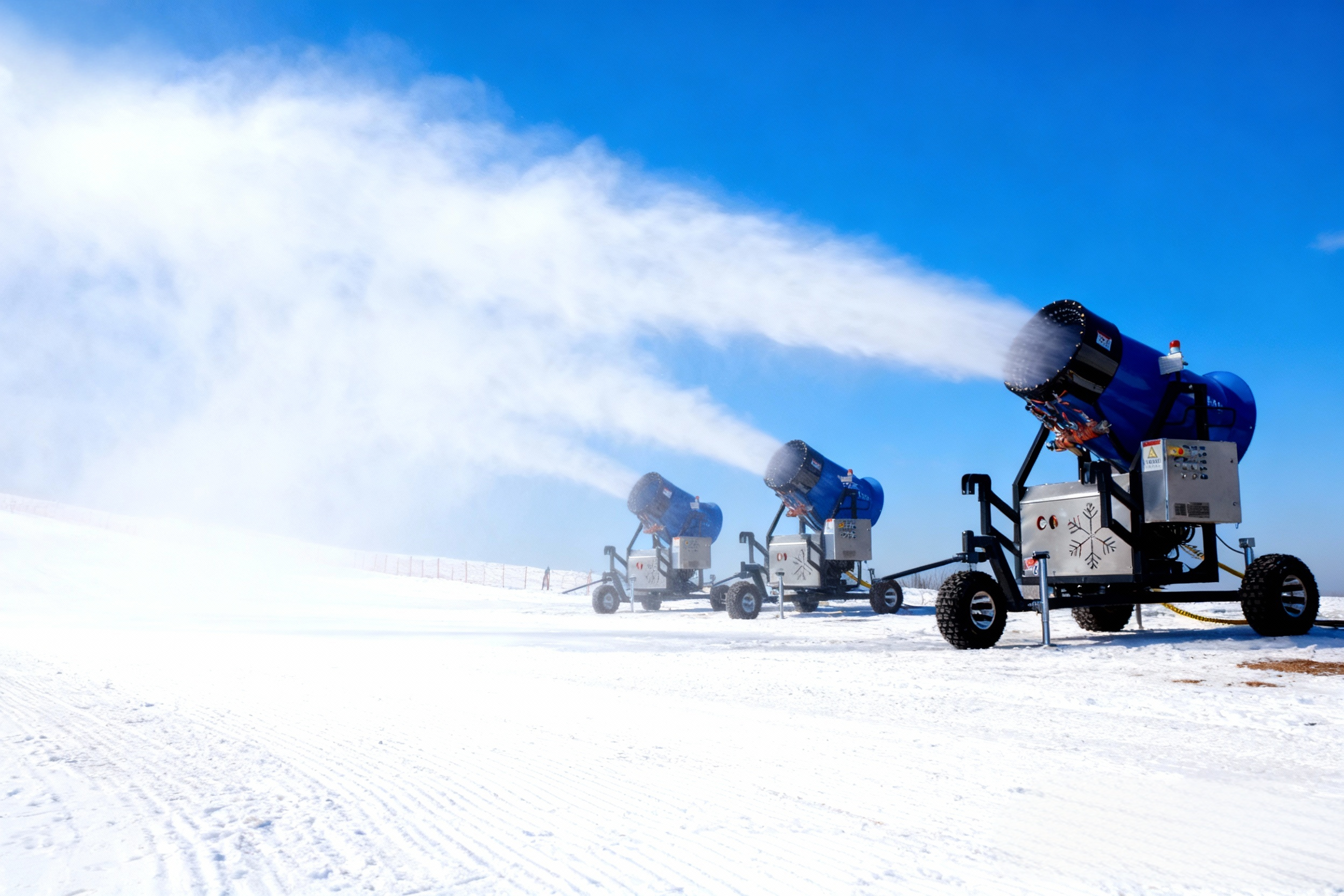
Choose a snow falling machine when the brief says “make it look magical.” Choose a snow spray machine when the brief says “put snow on this defined area.” Choose a snow cannon or all-weather production system when the brief says “keep this attraction covered and open.”
Real projects can combine them. An indoor park may use a high-output system for the base, a spray unit for touch-ups, and a falling machine above the entrance. Focusun’s overview of all-weather snow and ice solutions explains these roles, while its year-round winter attractions guide offers a broader planning view.
A useful quotation begins with the result, not a model number. Give the supplier your city, indoor or outdoor location, summer and winter temperature and humidity, target area, desired snow depth, opening hours, available power and water, installation height, and the date the attraction must open. Photos, drawings, and a simple visitor-flow plan help as well.
Then ask every bidder to state whether output is measured as ice production, finished snow, or coverage under defined conditions. Request utility consumption, included auxiliary equipment, installation scope, spare parts, operator training, and maintenance intervals. This makes proposals comparable and exposes costs that a bare machine price can hide. For a site-specific recommendation, send those details through the Focusun project enquiry page.
The best machine is the one designed for your required snow behavior. Falling machines sell the illusion of winter in the air. Spray machines give an operator controlled local coverage. Cannons and all-weather production systems create the volume needed for larger, longer-running attractions. Define the effect, climate, and daily snow demand first; the correct equipment category usually becomes clear before the model discussion begins.
A snow falling machine creates a gentle visual snowfall over a controlled zone, making it best for ambience. A snow spray machine directs powdery snow toward a smaller target and can provide local accumulation. A snow cannon is generally chosen for greater throw, heavier production, and larger terrain. However, “snow cannon” may mean a cold-weather fan gun or a refrigerated all-weather system. Confirm the production method, rated conditions, and whether the stated output refers to ice, finished snow, or covered area before comparing prices.
Most indoor snow parks need a production system that can maintain a playable snow base independently of outdoor weather. A refrigerated, all-weather snow-making system is therefore usually the core equipment. Snow spray machines can handle local replenishment, while snow falling machines add atmosphere at entrances, stages, or photo zones. The correct combination depends on floor area, target depth, indoor temperature, daily visitor load, and operating hours. Calculate daily snow loss and heat load before choosing capacity; room size alone does not reveal how much replacement snow the venue will need.
Some can, but the answer depends on the technology. A traditional snow cannon freezes atomized water in outdoor air and needs a favorable wet-bulb temperature, so warm or humid weather sharply limits production. A refrigerated all-weather machine makes snow mechanically and can operate above freezing within its specified design range. Certain snow spray and falling systems also have model-specific temperature limits. Never rely on a general phrase such as “high temperature.” Ask for rated output at your site’s actual air temperature and humidity, including the hottest conditions during planned operating months.
For a durable play layer, choose equipment designed to produce and replenish accumulated snow, normally an all-weather production system or a suitable snow cannon. A snow spray machine can build smaller activity zones or refresh worn sections, depending on its capacity and operating conditions. A snow falling machine is mainly selected for the airborne effect and may not build a base efficiently. Snow quality also changes with water, temperature, particle size, grooming, and visitor traffic. Tell the supplier whether guests will walk, tube, ski, build snowmen, or only take photographs.
There is no reliable single price because these three categories solve different jobs. Cost changes with daily output, temperature range, nozzle or fan configuration, refrigeration capacity, compressor, containerization, control system, shipping, installation, and auxiliary equipment. Site work—power upgrades, water treatment, drainage, piping, ventilation, and snow grooming—may also be significant. Ask for a total project quotation rather than a machine-only figure. It should separate equipment, freight, commissioning, training, spare parts, and estimated operating consumption, so competing offers can be compared on the same scope.
Coverage cannot be judged from tonnes per day alone. For falling snow, mounting height, discharge layout, air movement, and the desired visual density determine the useful zone. For spray machines, throw distance, nozzle angle, wind, snow dryness, and required depth affect the covered surface. For large snow systems, production hours, grooming, melt rate, and snow transport become equally important. Give the supplier a plan showing dimensions and obstacles, then request a proposed equipment layout and coverage assumptions. A measured site drawing is more dependable than a generic square-metre claim.
A small atmospheric falling machine may consume less in total than a large snow cannon, but that comparison is not meaningful unless both are asked to deliver the same result. Energy and water efficiency should be measured per useful amount of snow under stated site conditions. Traditional cannons avoid mechanical refrigeration but depend on cold, dry weather; all-weather systems consume refrigeration power in exchange for predictable production. Spray systems add compressed-air demand. Compare rated output, compressor and pump loads, standby power, water loss, operating hours, and the amount of snow that actually lands in the intended area.
Not necessarily. Suppliers sometimes use “mini snow cannon” for compact spray equipment, but a conventional resort snow cannon usually has a larger fan, higher water flow, longer throw, and a strong dependence on cold wet-bulb conditions. A snow spray machine is commonly selected for a stage, display, small play area, or targeted touch-up where mobility and direction are valuable. Compare process diagrams and utility lists, not names. If a quotation includes compressed air, refrigeration, an ice-making module, or only water atomization, those details reveal what the machine actually does.
Provide the project location, indoor or outdoor setting, temperature and humidity range, snow-covered area, desired depth, required visual effect, visitor activities, daily opening hours, and available production time. Include power supply, water quality, drainage, installation height, equipment access, noise limits, and delivery deadline. A drawing or short site video is especially useful. Also explain whether the priority is falling snow, quick local coverage, or a maintained base. With these inputs, a supplier can estimate capacity, recommend machine placement, identify auxiliary equipment, and state realistic performance assumptions.
Maintenance depends on the process, but routine work normally includes checking nozzles, filters, pumps, hoses, valves, sensors, fans or compressors, and cleaning parts exposed to water or snow. Refrigerated systems also require scheduled inspection of the refrigeration circuit and heat-rejection equipment by qualified technicians. Water quality matters because scale and blocked nozzles reduce performance. Before purchase, request a maintenance schedule, consumables list, recommended spare-parts package, remote-support terms, and local service responsibilities. Operators should record pressure, temperature, output, and faults so small changes are corrected before they cause downtime.
